
Chola Nadu Package
Kumbakonam to Thiruvarur & Nagapattinam – 13 Temples
Kumbakonam to Thiruvarur & Nagapattinam – 13 Temples
This tour covers famous temples and holy places between Kumbakonam, Thiruvarur, and Nagapattinam. It includes Shiva temples, Vishnu temples (Divya Desams), Murugan temples, and even a famous church.
Places Covered:
- Azhagaputhur – Ezhutharivu Nathar Shiva Temple
- Thirunariyur – Mangala Saneeswarar (for Sani dosham relief)
- Nachiyar Kovil – Srinivasa Perumal and Garuda Sevai
- Thirucherai – Saranatha Perumal (Divya Desam)
- Thirucherai – Saraparameswarar Temple
- Thirukannamangai – Vishnu Temple (Divya Desam)
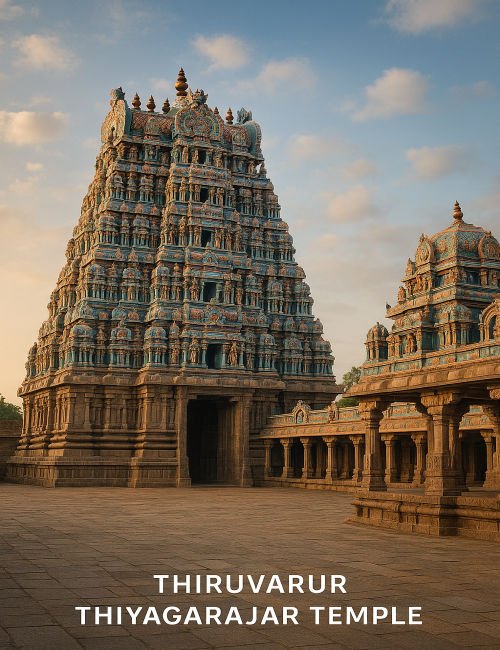
- Thiruvarur – Thyagaraja Swamy Temple (Very famous Shiva temple)
- Thirukkurungudi – Vishnu Divya Desam
- Sikkal – Famous Murugan Temple (Murugan with Vel story)
- Poravachery – Murugan Temple
- Nagapattinam – Neelayadhakshi Amman Temple
- Nagapattinam – Korakkar Siddhar Jeeva Samadhi
- Velankanni – Basilica of Our Lady of Good Health (Famous church)
About This Temple Tour Route
This 13-stop tour is one of our most varied routes, blending Shiva temples, Divya Desam Vishnu shrines, Murugan temples, and even a historic Christian pilgrimage site — the Basilica of Our Lady of Good Health in Velankanni. It’s a route that appeals not just to devotees of a single tradition, but to families with mixed devotional interests or travelers curious about the region’s broader religious heritage.
The journey moves from Kumbakonam through Azhagaputhur, Thirunariyur, and Nachiyar Kovil before reaching Thiruvarur — home to the historically and musically significant Thyagaraja Swamy Temple — and continues on to Sikkal, Nagapattinam, and finally Velankanni on the coast.
Highlights Along the Route
Thyagaraja Swamy Temple, Thiruvarur — One of the most revered Shiva temples in Tamil Nadu, closely associated with Carnatic music heritage and the Tamil saint-composer tradition. This is typically the centerpiece stop of the tour.
Mangala Saneeswarar, Thirunariyur — Specifically visited by devotees seeking relief from Sani dosham (Saturn-related astrological afflictions), making this a meaningful stop for those combining this route with broader planetary worship.
Sikkal Murugan Temple — Known for its unique legend of Lord Murugan and the Vel (spear), this is one of the significant Murugan shrines along the coastal belt.
Velankanni Basilica — The Basilica of Our Lady of Good Health draws pilgrims of all faiths and is one of the most visited Christian pilgrimage sites in South India, giving this tour a distinctive multi-faith character.
Nagapattinam temples — Including the Neelayadhakshi Amman Temple and the Korakkar Siddhar Jeeva Samadhi, both significant stops for devotees exploring the coastal town’s spiritual heritage.
Suggested Duration & Pacing
Given the coastal distance involved — this route extends further from Kumbakonam than most of our other temple circuits — we recommend planning this as a full single day with an early start, or a relaxed two-day trip if you’d like time to properly explore Velankanni and the Nagapattinam temples without rushing.
A single-day plan typically starts around 6:00 AM from Kumbakonam and returns by early evening, covering all 13 stops with reasonable but efficient time at each. A two-day plan allows for a more leisurely pace, particularly useful for families wanting to spend more time at Velankanni or combine the trip with a stay near the coast.
Getting There: Vehicle & Booking Details
We provide this route with a choice of sedans, SUVs, and tempo travellers depending on your group size, each with an experienced driver familiar with the coastal roads connecting Kumbakonam, Thiruvarur, and Nagapattinam. Since this route covers a longer distance than our purely Navagraha-focused packages, vehicle comfort and AC options are worth considering, especially for a single-day trip.
Contact us with your preferred travel date and group size, and we’ll quote a package that accounts for the full distance, including return travel to Kumbakonam.
Temple-by-Temple Guide
Ezhutharivu Nathar, Azhagaputhur — A Shiva temple whose name reflects an association with writing and knowledge (ezhuthu), traditionally visited by those seeking clarity in learning, communication, or academic pursuits.
Mangala Saneeswarar, Thirunariyur — A shrine specifically dedicated to Saturn (Sani), visited by devotees seeking relief from Sani dosha — one of the more targeted astrological remedy temples on this route, distinct from the main Navagraha circuit.
Nachiyar Kovil — Srinivasa Perumal & Garuda Sevai — This Vishnu temple is well known for its unique Garuda Sevai ritual, where the temple’s Garuda (eagle vahana) idol is traditionally believed to visibly respond during a specific annual procession — a distinctive practice that draws devotees from across the region.
Thirucherai — Saranatha Perumal (Divya Desam) & Saraparameswarar — This village is home to twin temples: a Vishnu shrine honoured as one of the 108 Divya Desams, and an accompanying Shiva temple, reflecting the area’s dual Shaiva-Vaishnavite devotional heritage.
Thirukkannamangai Vishnu Temple (Divya Desam) — Another of the Divya Desams praised in Alwar hymns, adding to this route’s strong Vaishnavite presence alongside its Shiva and Murugan shrines.
Thyagaraja Swamy Temple, Thiruvarur — One of the most significant Shiva temples on this entire route, closely associated with the Ajapa Natanam dance form of Shiva and deeply linked to Carnatic music heritage through the saint-composer Thyagaraja. This temple is typically the centrepiece stop of the day.
Thirukkurungudi (Vishnu Divya Desam) — A Vishnu shrine recognized among the 108 Divya Desams, known in Alwar tradition for depicting the deity in multiple forms representing different phases of time — past, present, and future.
Sikkal Murugan Temple — Associated with the legend of Lord Murugan and the Vel (spear), this temple is one of the significant Murugan shrines along the coastal belt, particularly active during Skanda Sashti celebrations.
Poravachery Murugan Temple — A smaller, more locally significant Murugan shrine, reflecting the strong Murugan devotional tradition that runs throughout this coastal region.
Neelayadhakshi Amman Temple, Nagapattinam — A prominent Amman temple in the coastal town, associated in local tradition with Shakti worship and widely visited by devotees seeking the goddess’s protection and blessings.
Korakkar Siddhar Jeeva Samadhi, Nagapattinam — The resting place (samadhi) of a revered siddhar (mystic saint), venerated by devotees seeking spiritual blessings and believed to hold particular significance for those drawn to the siddha tradition of Tamil spirituality.
Velankanni Basilica — The Basilica of Our Lady of Good Health is one of the most visited Christian pilgrimage sites in India, sometimes referred to as the “Lourdes of the East.” It draws pilgrims of all faiths, many visiting in connection with prayers for healing and well-being, and stands as a powerful symbol of this region’s multi-faith devotional character.
Darshan Tips & Local Insights
Dress code across faiths — Since this route uniquely combines Hindu temples with the Velankanni Basilica, it’s worth noting that dress expectations differ slightly. Temple visits call for traditional modest attire, while the Basilica, though also expecting modest dress, is generally more relaxed about specific traditional clothing requirements — still, covered shoulders and knees are recommended at both.
Best time to visit Thyagaraja Swamy Temple — Thiruvarur’s Thyagaraja Swamy Temple is best visited during the morning hours before the midday closure, both to avoid the heat and to catch the temple’s daily rituals at a more unhurried pace, given its size and significance as the day’s centrepiece.
Sikkal Murugan Temple during Skanda Sashti — If your visit falls near the Skanda Sashti festival period, expect significantly larger crowds at Sikkal. Devotees specifically planning around this festival should account for extra time and possibly an earlier start.
Visiting Velankanni respectfully — The Basilica welcomes visitors of all backgrounds, but as an active place of Christian worship, visitors are asked to maintain a respectful, quiet demeanour, particularly during mass timings. Photography inside the main sanctum area is often restricted, so it’s worth checking signage on arrival.
Coastal weather considerations — Since this route extends toward the coast, humidity and heat can be more noticeable in the afternoon, particularly around Nagapattinam and Velankanni. Carrying water and light, breathable clothing is worth planning for, especially during summer months.
Frequently Asked Questions
How far is Velankanni from Kumbakonam?
Velankanni is a coastal town roughly 2 to 2.5 hours from Kumbakonam by road, making this one of the longer routes in our temple tour offerings.
Can this tour be done in one day?
Yes, with an early start around 6:00 AM, most travelers complete the full 13-stop circuit and return to Kumbakonam by evening, though a two-day trip allows for a more relaxed pace.
Is the Velankanni Basilica open to visitors of all faiths?
Yes, the Basilica of Our Lady of Good Health welcomes pilgrims and visitors regardless of religious background, and is one of the most visited pilgrimage sites in South India.
Can I customize this route to skip certain temples?
Yes, if you’d prefer to focus on specific stops — for example, prioritizing Thiruvarur and Velankanni over some of the smaller temples — let us know when booking and we can adjust the itinerary.
Is this tour suitable for families with children or elderly members?
Yes, particularly if planned as a two-day trip. The single-day option involves longer hours on the road given the coastal distance, so a relaxed pace may suit families better.
Do you provide meal stop recommendations along this route?
Yes, our drivers are familiar with reliable food stops along the way, particularly around Thiruvarur and Nagapattinam, and can plan breaks around your preferred meal timing.
Is it appropriate to visit both Hindu temples and the Velankanni Basilica in the same trip?
Yes, this multi-faith route is one of the more distinctive aspects of this tour, and many travelers appreciate the opportunity to experience both traditions in a single well-planned day.
What is the significance of the Thyagaraja Swamy Temple beyond being a Shiva temple?
Beyond its religious importance, the temple is closely tied to Carnatic music heritage through its association with the Ajapa Natanam dance form and the broader devotional music tradition of the region.
Can I book just the Velankanni portion of this route separately?
Yes, if you’re primarily interested in visiting Velankanni without the full 13-stop temple circuit, we can arrange a more focused trip. Let us know your specific priorities when booking.
How crowded does this route get during major festivals?
Nagapattinam and Velankanni both see significant crowds during their respective festival periods (Church feast days at Velankanni, and various temple festivals at the Hindu shrines). If avoiding crowds is a priority, ask us about quieter travel windows when booking.
Why This Route Is Worth Your Time
Few pilgrimage routes in Tamil Nadu offer the kind of devotional variety this one does — Shiva temples steeped in Tevaram tradition, Vishnu shrines from the Divya Desam list, Murugan temples tied to distinctive local legends, and a major Christian pilgrimage site, all within a single well-planned day or two from Kumbakonam. For travelers curious about the region’s broader religious heritage rather than a single-tradition circuit, this route offers a genuinely comprehensive picture, without requiring separate trips to cover each tradition individually. It’s also one of our routes most frequently requested by mixed-faith families and groups wanting an inclusive, shared travel experience.
Do you offer a shorter version of this route for travelers with limited time?
Yes, if your schedule doesn’t allow for the full 13-stop circuit, we can prioritize based on your interests — for example, focusing on Thiruvarur and Velankanni as the two centerpiece stops while treating the smaller shrines as optional.
Do you assist with planning the return journey timing to Kumbakonam?
Yes, given the length of this route, we plan the return leg around a realistic evening arrival time back in Kumbakonam, factoring in temple visit durations and typical traffic conditions along the coastal roads.
Start a Reservation
Experience the divine energy of Chola Nadu temples. Reserve your seat now for a peaceful and powerful temple journey.